Trauma Informed Care and The Virtues of Yoga
Resonate over Regulate: Why Trauma-Informed Action is an Act of Decolonization
In the mainstream wellness and therapeutic landscapes, we are constantly bombarded with a single, aggressive directive: regulate your nervous system. We are told that if we just breathe a certain way, check off the right sensory protocols, or follow a strict biomedical formula, we can override our distress, fix what is broken, and return to an idealized baseline of perfect functioning.
But for those navigating complex, developmental, or permanent physiological injuries—whether from systemic violence, medical trauma, chronic illness, or profound structural adversity—this formulaic approach feels less like healing and more like a demand for compliance.
Operating through a trauma-informed lens is not a clinical trend; it is a deeply yogic, Taoist, and philosophical alignment. When we shift our focus from rigid regulation to structural and relational resonance, we actively decolonize our healing practices. We shift our goal from "fixing" an unchangeable injury to supporting whole-body coherence in the present moment
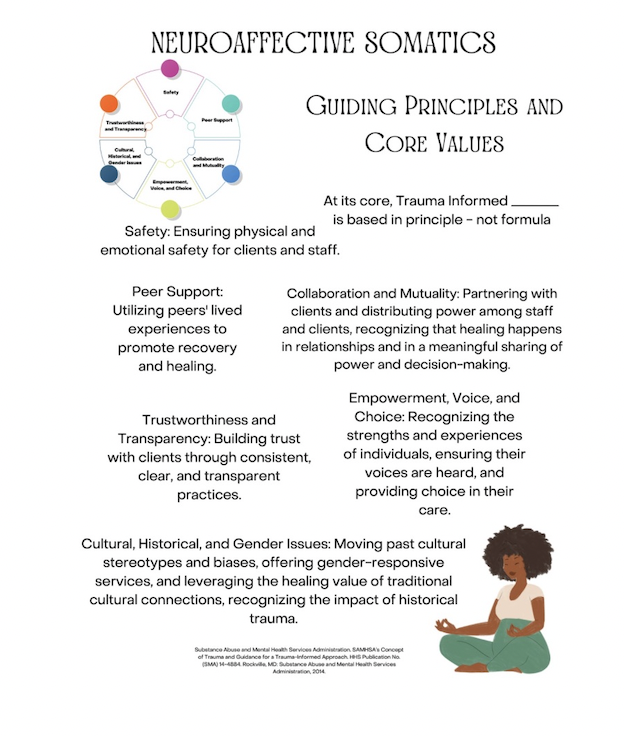
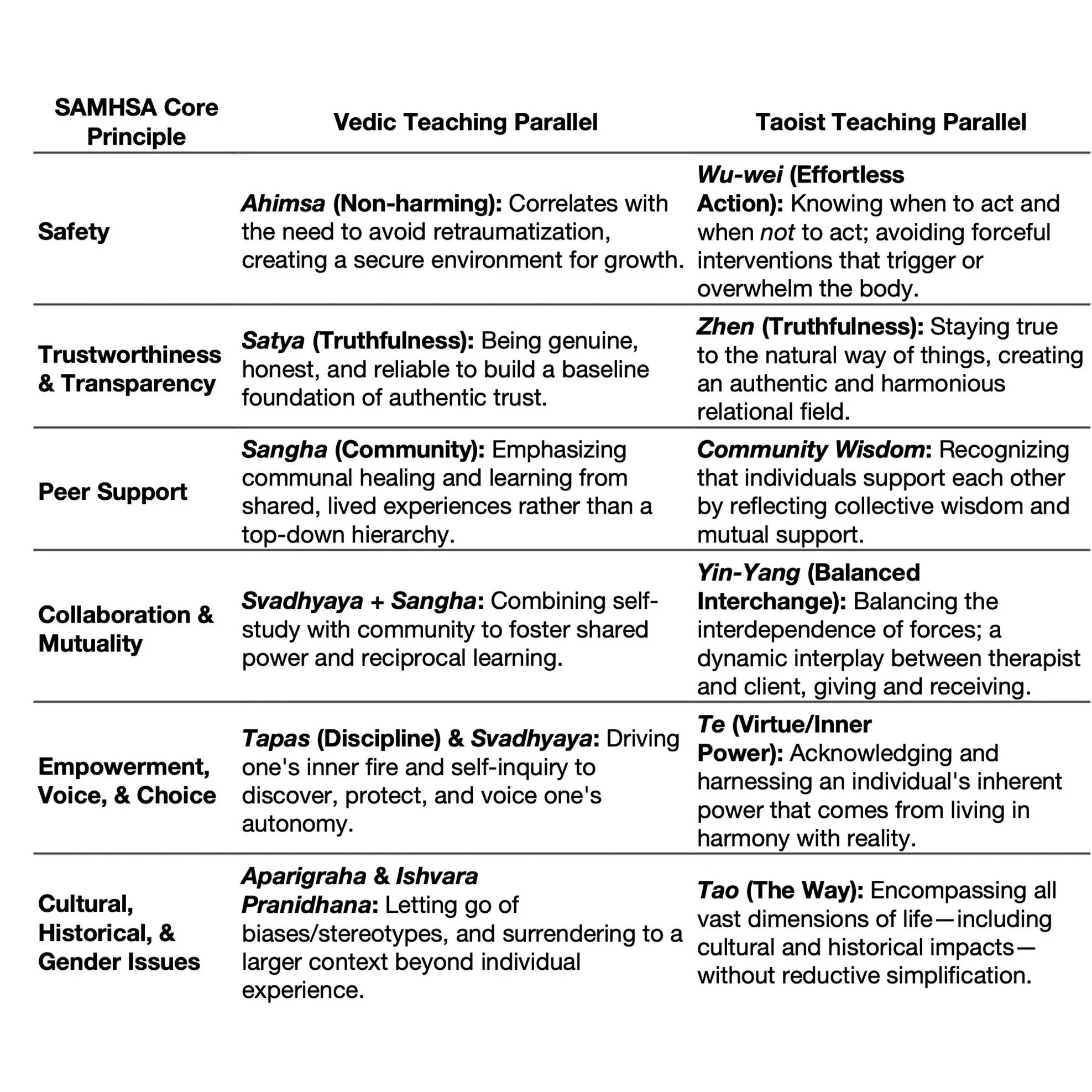
The Parallel Maps of Ancient Wisdom and Trauma-Informed Principles
To understand why a trauma-informed lens is inherently a decolonial practice, we can look directly at the striking parallels between the Substance Abuse and Mental Health Services Administration (SAMHSA) framework for trauma-informed care and ancient Vedic and Taoist teachings
Decolonization: Moving Beyond the "Formula"
Westernized wellness often views the body as a machine to be optimized, managed, and controlled. This is a colonized framework—one rooted in dominance, extraction, and the erasure of context. When a practitioner approaches a survivor with a rigid formula, demanding that they force their body into a state of "calm," it ignores the historical, systemic, and environmental realities that made the body hyper-vigilant or dissociative in the first place.
Operating through a trauma-informed lens changes the core question from "What is wrong with you, and how do we fix it?" to "What happened to you, and how does your body carry it?"
By honoring Satya (truth) and Wu-wei (non-forcing), we stop trying to conquer the body's defensive states. We acknowledge that survival adaptations are intelligent. Decolonizing healing means dismantling the clinical hierarchy, centering client choice, and recognizing that our nervous systems do not heal in isolation—they heal through communal connection (Sangha) and relational fields.
Neuroaffective Somatics: A Framework for Permanent and Complex Injuries
What happens when an injury cannot be "fixed"? When chronic illness, neurodivergence, structural trauma, or a physical injury is permanent, the promise of a complete "cure" becomes a form of spiritual bypassing.
This is where Neuroaffective Somatics offers a radical path forward. Rather than relying on traditional top-down regulation models that demand a body perform outside its capacity, Neuroaffective Somatics maps healing through resonance, orientation, and structure: [1, 2]
Resonance Over Regulation: Your body functions like an orchestra. If a permanent injury has altered the instrumentation, forcing it to play a standard score will only create friction. Neuroaffective Somatics looks at how the fascia, breath, and relational fields can find coherence exactly as they are right now.
Honoring the Whole-Body Landscape: By integrating the deep structural realities of fascia science and quantum biology with the energetic wisdom of Chinese medicine and Taoist alchemy, we can support the whole person. We learn to track the body’s innate gravitational and relational fields without needing to force an altered state.
Acceptance as a Radical Act: If the injury is complex or permanent, neuroaffective somatic practices provide a container to hold the duality of grief and vitality (Yin-Yang). It allows us to step out of the exhausting cycle of fighting our own biology and instead cultivate a deeply grounded, embodied intelligence within our unique physical structure.
Cultivating Whole-Body Coherence
We cannot always alter the external systems that wound us, nor can we always reverse complex physical and emotional injuries. But we can alter how we meet ourselves. By weaving trauma-informed care together with ancient somatic lineages, we stop treating our bodies as terrains to be policed. We invite true, whole-body healing—building capacity, reclamation, and deep relational resonance from the inside out.