Orientation Through Structure & Form
This work approaches the nervous system through structure, relationship, and perception, rather than through diagnosis or hierarchy.
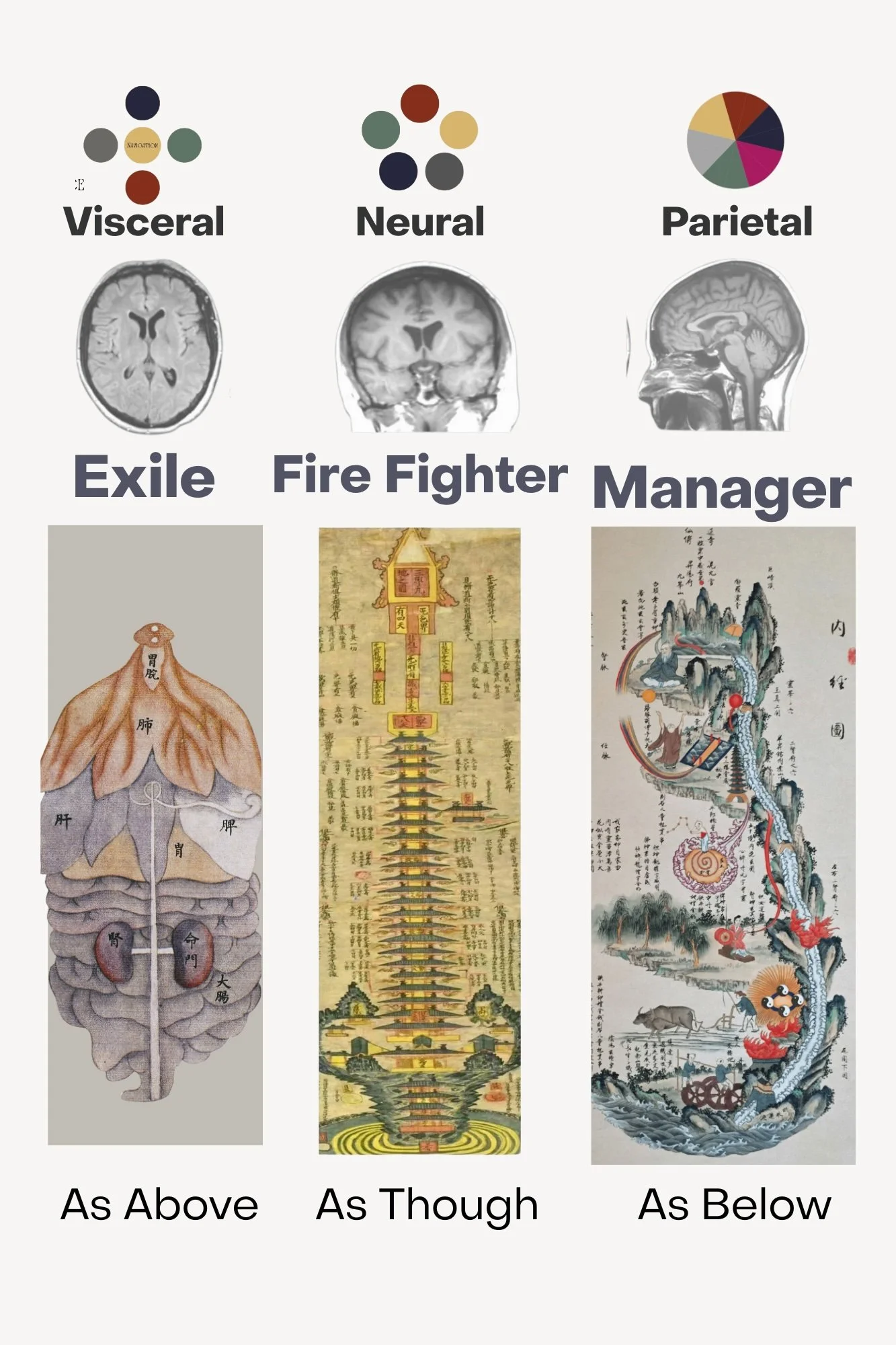
The image above introduces a tri-layered orientation that appears consistently across body, brain, and classical Chinese internal maps:
Visceral — deep, inherited, load-bearing processes
Neural — movement, response, and adaptive action
Parietal — orientation, meaning, and organizing perspective
These layers are not categories of people or parts to be managed. They are modes of experience that arise through tissue, timing, and attention.
Rather than asking which layer is “correct,” this framework invites you to notice where perception is organizing from in any given moment.
Bias is rendered explicitly here: orientation always arises from a position in the body. By making that position visible, coherence becomes navigable.
The Role of the Neijing Tu
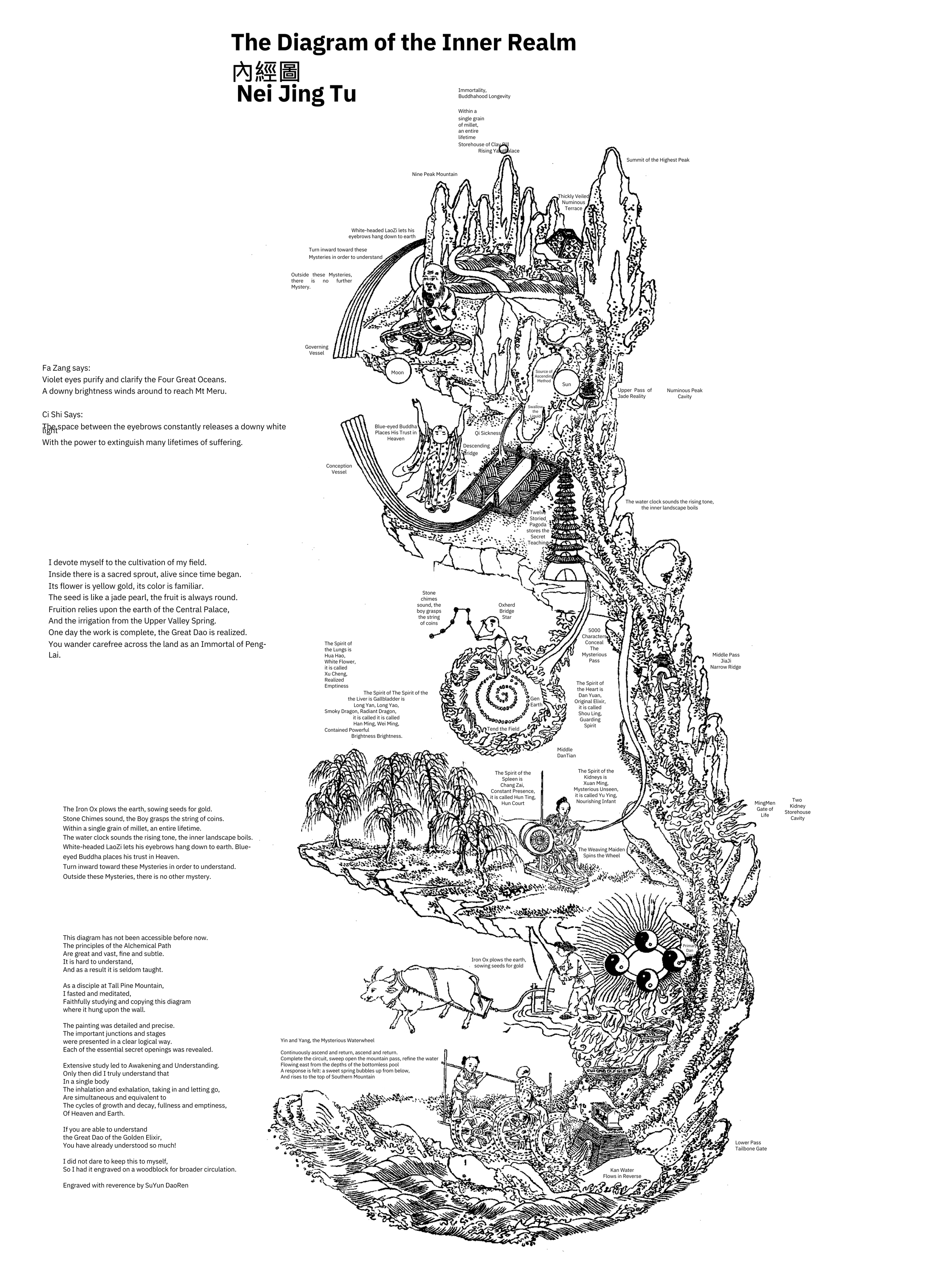
Full English Translation of the Neijing Tu
The Neijing Tu, a Taoist diagram that maps the human body to cosmic principles, symbolizes the interconnectedness of all things and underscores the idea that every element within the universe (or society) holds value and purpose. This ancient text serves as a metaphorical guide to understanding how individual differences (in abilities, perceptions, or functions) are natural variations within the human spectrum, rather than deviations from a norm.
Integration of Concepts: Tensegrity and Social Structures
Tensegrity, a term used in various contexts from architecture to biology, describes a structural principle based on the use of isolated components in compression inside a net of continuous tension. In the context of disability and society, it can metaphorically represent how individual needs and societal structures can be balanced and supported through a network of social supports and inclusive practices.